In this guide
The 2026 ERP Landscape: Why India is Choosing Open Source
As we move through 2026, the Indian SaaS landscape has undergone a radical shift. Small and Medium Enterprises (SMEs) are prioritizing ERPNext implementation cost savings to reinvest in growth.
Traditional giants like SAP and Oracle continue to dominate, but their "per-user" licensing models are a bottleneck. In contrast, ERPNext, built on the robust Frappe Framework, offers a "license-free" existence for Indian firms.
Key Drivers for ERPNext Adoption in 2026:
- Unlimited User Scalability: Unlike Odoo or SAP, ERPNext doesn't penalize you for growth.
- Indian Compliance Mastery: Real-time GST integration and TDS automation are native.
- Mobile-First Workforce: Responsive PWA allows real-time factory floor updates.
ERPNext Implementation Cost for Small Businesses
For startups and small firms with 5–20 users, the focus is on speed and standard modules like Accounting and CRM.
| Business Size | Typical Cost (INR) |
|---|---|
| Small Startup (Standard) | ₹1.5L – ₹3L |
| Growing SME (Multi-module) | ₹3L – ₹6L |
ERPNext Implementation Cost for Manufacturing Companies
Manufacturing projects are more complex, requiring deep Bill of Materials (BOM) setup and production planning.
| Company Type | Cost Range (INR) |
|---|---|
| Small Factory (Single Unit) | ₹4L – ₹8L |
| Large Manufacturer (Multi-Location) | ₹8L – ₹15L |
The Anatomy of ERPNext Costs
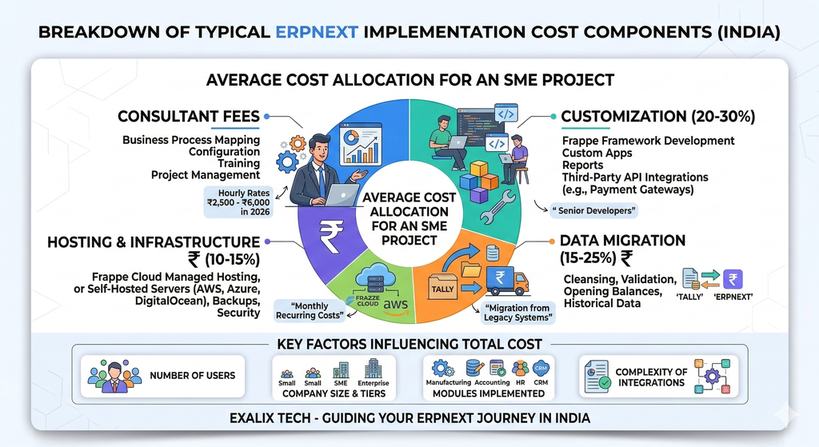
To understand the budget, one must look at the ERPNext implementation services as an engineering project, not a software purchase.
1. Infrastructure & Hosting (The Foundation)
In 2026, you have three primary paths for hosting ERPNext in India:
- Frappe Cloud: Recommended for most. Managed updates and integrated marketplace.
- Self-Hosted: Best for firms with internal IT for Linux administration.
- On-Premise: High upfront server costs (₹1.5L+). Only for low-connectivity zones.
2026 Cost Matrix: Implementation & Consulting
Consulting fees at Exalix Tech are categorized into three distinct tiers to ensure transparency for Indian businesses.
| Project Scope | Target Business | 2026 Pricing (INR) | Duration |
|---|---|---|---|
| Vanilla Implementation | Trading/Service startups using standard modules. | ₹1,50,000 – ₹3,00,000 | 4–6 Weeks |
| Standard Manufacturing | Multi-level BOM, Production Planning. | ₹4,50,000 – ₹8,50,000 | 3–4 Months |
| Enterprise / Custom | 100+ users, IoT, and complex API integrations. | ₹12,00,000 – ₹35,00,000+ | 6–12 Months |
Customization: The "Double-Edged Sword"
If your business logic requires unique workflows, our ERPNext customization experts ensure the system scales with you without breaking core updates.
"The goal of a successful ERPNext rollout is to fit 80% of your business into the standard product." - Jeel Patel, COO of Exalix Tech.
The Migration Trap: Tally to ERPNext
Most Indian businesses require a Tally to ERPNext migration. This process involves data cleansing and opening balance reconciliation to ensure financial accuracy.
Migration Budget: Expect to spend 15%–20% of your total budget solely on data integrity and verification.
ERPNext vs SAP vs Odoo: 5-Year TCO Analysis
ERPNext
₹15L – ₹25L
Zero licensing. Pure value-driven implementation.
Odoo Enterprise
₹45L – ₹65L
Modular pricing + Per-user fees.
SAP Business One
₹1.2Cr – ₹2.5Cr
Heavy AMC and mandatory upgrades.
Final Thoughts: ERPNext Implementation Cost in India
Choosing an ERP is a long-term investment. While ERPNext implementation cost in India is significantly lower than proprietary alternatives like SAP, its real value lies in its flexibility for SMEs. By focusing on a lean MVP first, businesses can achieve ROI much faster.